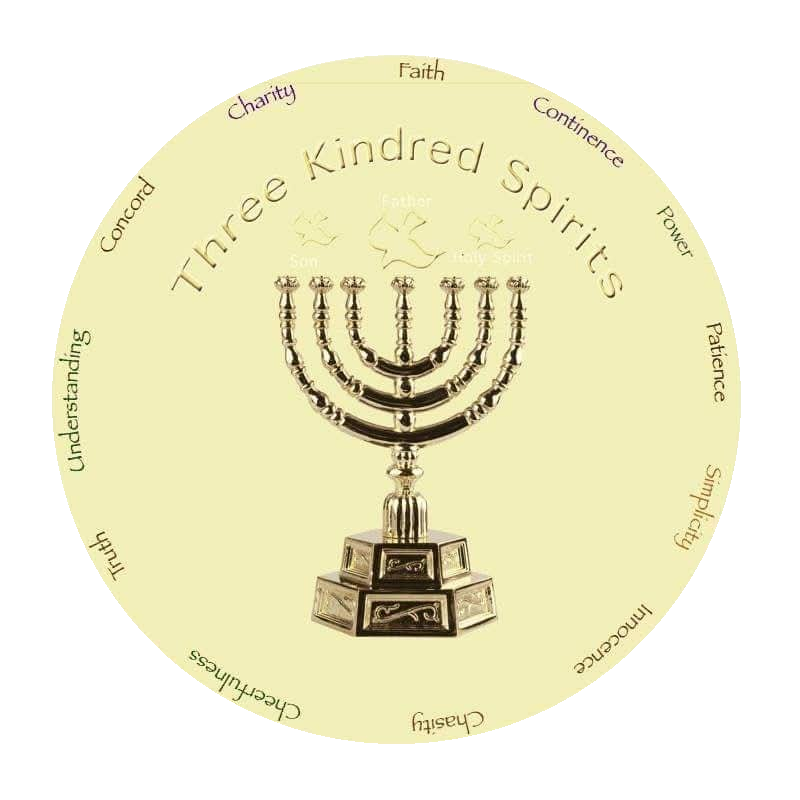
Why the Menorah
The menorah (מְנֹרָה, from the Hebrew root meaning “light”) is the lampstand YudHeyVavHey Himself commanded to stand in His house. In Exodus 25:31, He told Moses to hammer it from pure gold — one piece, seven lamps, almond blossoms — and set it in the tabernacle before the veil. It burned continually (Leviticus 24:2), a light that never went out in His presence.
The prophet Zechariah saw it in vision — a golden lampstand fed by two olive trees — and heard the word: “Not by might, nor by power, but by My Ruach” (Zechariah 4:6).
In Revelation, Yehoshua Himself walks among seven golden lampstands (Revelation 1:12-13), which are the assemblies of His people (Revelation 1:20).
We chose the menorah because it was His idea first — His light, in His house, from the beginning.
The Twelve Stones
The high priest wore twelve stones over his heart, one for each tribe of Israel (Exodus 28:17-21). John saw those same twelve stones in the foundations of the New Jerusalem (Revelation 21:19-20). Around our menorah, each of the twelve words shines in its stone’s color:
- Faith — Jasper, deep red — the stone of Benjamin
- Continence — Sapphire, heavenly blue — the stone of Issachar
- Power — Chalcedony, sky blue — the stone of Zebulun
- Patience — Emerald, living green — the stone of Judah
- Simplicity — Sardonyx, layered bronze — the stone of Manasseh
- Innocence — Sardius (carnelian), fiery red-orange — the stone of Reuben
- Chastity — Chrysolite, olive gold — the stone of Ephraim
- Cheerfulness — Beryl, clear aqua — the stone of Asher
- Truth — Topaz, golden yellow — the stone of Simeon
- Understanding — Chrysoprasus, apple green — the stone of Naphtali
- Concord — Jacinth, deep indigo — the stone of Dan
- Charity — Amethyst, royal purple — the stone of Gad
Twelve tribes. Twelve stones. Twelve words. The priest carried them over his heart; the city is built on them; and they shine around the light He commanded.
About Our Bibles
Every verse you read here comes from the oldest texts we have — the Hebrew Masoretic Text for the Old Testament and the earliest Greek manuscripts (like Codex Sinaiticus) for the New Testament. We read from the Literal Standard Version (LSV), a public-domain translation made directly from those ancient sources, word for word, with nothing added and nothing taken away.
You will not find man’s opinions here, and you will not find reworded traditions. Only the Scriptures as they were written — the Word does not contradict itself.
When a verse is shown, the Greek or Hebrew words underneath come straight from those same ancient manuscripts, with the literal English meaning beside them. What was added by translators to help the English read smoothly is marked in [brackets], so you always know exactly what the text says and what was added.
This is the whole truth, from the beginning, as it was given.

